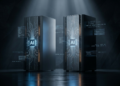

AMD Helios AI rack-scale system sparks a new phase of competition in data center AI by pledging to deliver gigawatt-scale GPU compute and challenge Nvidia’s industry lead as of 2026. At the center of this announcement is AMD’s effort to position Helios as the most scalable and energy-conscious solution for training frontier AI models and powering the next generation of agentic AI hardware.
The AMD Helios AI rack-scale system, expected to be deployed in hyperscale data centers, represents AMD’s most ambitious push into rack-scale computing to date. For non-technical readers, rack-scale systems bundle compute, networking, and storage in a fully integrated unit, allowing enterprises to easily expand AI capacity without manually assembling disparate components. This approach simplifies scaling, reduces deployment time, and optimizes data flows between CPUs, GPUs, and storage arrays, all of which are critical for modern AI workloads.
Technical details shed light on AMD’s new Instinct MI450 GPU at the heart of Helios. According to the official release, Helios delivers up to 160 petaflops of FP16 compute per rack, targeting large-scale training and inference for models such as generative AI and agentic systems. When stacked against Nvidia’s Vera Rubin rack and Grace Blackwell platforms, AMD claims Helios offers a 15% performance uplift in multi-rack scenarios, backed by early third-party benchmarks. More granular comparisons and a full spec breakdown can be found in this in-depth analysis of Nvidia Vera Rubin versus AMD Instinct-based systems.
One critical aspect is availability and pricing. AMD aims to undercut Nvidia’s premium by offering flexible configurations, with volume shipments starting Q2 2026 and pricing reportedly 10–15% below competing Nvidia racks. Enterprise buyers are eyeing these savings, but the challenge remains around software support. AMD pushes its ROCm open-source software stack as a CUDA alternative, pledging tighter integration and regular updates, but industry inertia around CUDA remains a challenge for rapid adoption.
Historically, AMD has struggled to wrest AI accelerator market share from Nvidia due to limited ecosystem support and slower time-to-market. Helios is positioned as a turning point. By aligning with major data center buyers and focusing on agentic AI hardware, AMD signals a deeper commitment to the fast-growing $1.4 trillion AI accelerator market projected for 2030. The question is whether this strategy can overcome Nvidia’s first-mover advantage.
The competitive landscape leans heavily on independent benchmarks, which have been sparse at launch. For technical buyers, the absence of a full spec-to-spec comparison—such as tensor core density, power draw, and inter-GPU bandwidth—makes it difficult to verify AMD’s claims. However, early adopters praise Helios for optimized system-level efficiency and rack density, metrics that are crucial for hyperscalers facing energy and cooling bottlenecks. A growing number of deep dives into AI accelerator chip architectures provide helpful context, such as this comprehensive guide to AI accelerator chips.
AMD’s customer roster includes Microsoft Azure, Meta, OpenAI, Oracle, and Anthropic—companies at the center of global AI development. According to detailed reporting from CNBC, Microsoft and OpenAI have committed to large-scale Helios deployments for their next-generation LLM infrastructure. Anthropic and Meta, meanwhile, are betting on Helios for both training and inference, betting on the system’s rack-scale integration to achieve lower total cost of ownership over time.
A standout partnership is AMD’s deal with Anthropic for a 2-gigawatt AI data center rollout. That scale reflects broader trends in data center infrastructure, where energy consumption has become a defining concern. AMD touts Helios’ industry-low power draw per petaflop, but the implications are significant: with gigawatt-scale deployments, buyers must invest heavily in green power, advanced cooling, and new facility design to mitigate the environmental footprint of frontier AI model training.
The Venice-X CPU, AMD’s companion launch, complements Helios in high-density AI servers. Venice-X builds on Zen 6 cores and features high-bandwidth CXL memory, optimized for orchestration and large dataset handling. Its rollout, slated for late 2026, targets CPU-intensive agentic AI workflows and is viewed as AMD’s counter to Nvidia’s Grace CPU. For deployment details and architectural insights, industry watchers are closely tracking Venice-X’s ability to handle mixed GPU-CPU compute at rack scale.
As Dr. Lisa Su noted at AMD’s 2026 keynote, the company views Helios as its entry point into the projected $1.4 trillion AI accelerator market 2030 and the era of agentic AI hardware. Su’s roadmap ties AMD’s long-term growth to disrupting rack-scale computing and democratizing access to hyperscale GPU compute. However, as The Register points out, AMD’s path is complicated by Nvidia’s entrenched ecosystem and the inertia of decades-long data center relationships.
As the market moves toward more energy-hungry, model-centric AI computing, Helios represents more than just a technical milestone—it signals a strategic attempt to redefine data center economics and architecture. Long-term, the sustainability of gigawatt-scale deployments and the adoption of open software platforms such as ROCm will define the next wave of AI infrastructure winners. Those decisions will determine whether AMD can shift the balance in the tightly contested landscape of rack-scale data center AI.
Frequently Asked Questions (FAQ):
Q: How does AMD Helios compare to Nvidia Vera Rubin?
A: Early benchmarks indicate that the AMD Helios AI rack-scale system offers comparable—sometimes superior—FP16 compute performance, with a 15% boost in multi-rack scaling and favorable energy efficiency. However, Nvidia continues to lead in software ecosystem maturity and broader deployment history.
Q: Who are the main AMD Helios customers?
A: Confirmed Helios customers include Microsoft Azure, OpenAI, Meta, Oracle, and Anthropic, all deploying Helios for large-scale AI training and inference. For deployment strategies of agentic AI, see this detailed agentic AI infrastructure guide.
Q: What are rack-scale systems?
A: Rack-scale systems are integrated solutions that package compute, storage, and networking in a single unit, streamlining deployment for enterprises and hyperscalers building AI data centers.
Q: What is AMD’s strategy for the AI accelerator market 2030?
A: AMD aims to challenge Nvidia by focusing on open software ecosystems, energy-efficient system design, and strategic partnerships with cloud and AI leaders—all oriented toward capturing a share of the projected trillion-dollar AI accelerator market by 2030. For executive insights, see AMD’s official Helios announcement.
The AMD Helios AI rack-scale system is more than an incremental upgrade—it’s an inflection point in the evolution of AI computing. By combining technical ambition with strategic partnerships and energy-aware design, AMD is fighting to reshape the balance of power in the data center AI market. Success will depend on sustained innovation, ecosystem maturity, and the ability to deliver cost-effective, high-performance infrastructure at global scale.